

In the rapidly evolving world of modern agriculture, growers are constantly seeking efficient, sustainable, and high-yielding methods for producing food. Two systems that frequently appear in these conversations are hydroponics and aquaponics. Both approaches offer soil-less cultivation, impressive space efficiency, and the ability to grow crops year-round. Yet, despite their similarities, hydroponic and aquaponic systems differ substantially in how they operate, how nutrients are delivered, and the kind of ecosystems they create. Understanding these differences is essential for growers deciding which method best matches their goals, resources, and sustainability priorities.
This article explores the main difference between hydroponics and aquaponic systems, discusses how each method works, examines their advantages and disadvantages, and helps you determine which approach may be right for your needs.
What Is Hydroponics?
Hydroponics is a method of growing plants without soil, using a nutrient-rich water solution to deliver essential minerals directly to plant roots. Instead of receiving nutrients from organic decomposition in soil, plants get exactly what they need from a carefully prepared, scientifically balanced nutrient mix.
Hydroponic systems come in several variations, such as Deep Water Culture (DWC), Nutrient Film Technique (NFT), drip systems, ebb-and-flow setups, and aeroponics, but all rely on the same foundational principle: providing water, oxygen, and nutrients in a controlled environment.
How Hydroponics Works
- The water reservoir holds a nutrient solution.
- A pump and delivery system circulates the solution to the plant roots.
- Inert growing media like perlite, coco coir, or rock wool support root systems.
- Grow lights often supplement or replace natural light.
- pH and nutrient levels must be regularly monitored and adjusted.
Hydroponics is highly efficient because plants do not expend energy searching for nutrients; everything is provided directly and precisely.
What Is Aquaponics?
Aquaponics is an integrated agricultural system combining aquaculture (fish farming) with hydroponics. In this closed-loop ecosystem, fish waste provides the nutrients that plants need. Beneficial bacteria play a crucial role by converting toxic fish waste (ammonia) into plant-usable forms (nitrates). The plants, in turn, filter and purify the water before it returns to the fish tank.
How Aquaponics Works
- Fish tanks produce waste containing ammonia.
- Biofilters and nitrifying bacteria convert ammonia → nitrites → nitrates.
- Plant beds absorb the nitrates as nutrients.
- Cleaned water returns to the fish tank.
- The cycle repeats continuously.
Aquaponics is essentially nature’s nutrient cycle recreated in a controlled environment.
The Main Difference Between Hydroponics and Aquaponic Systems
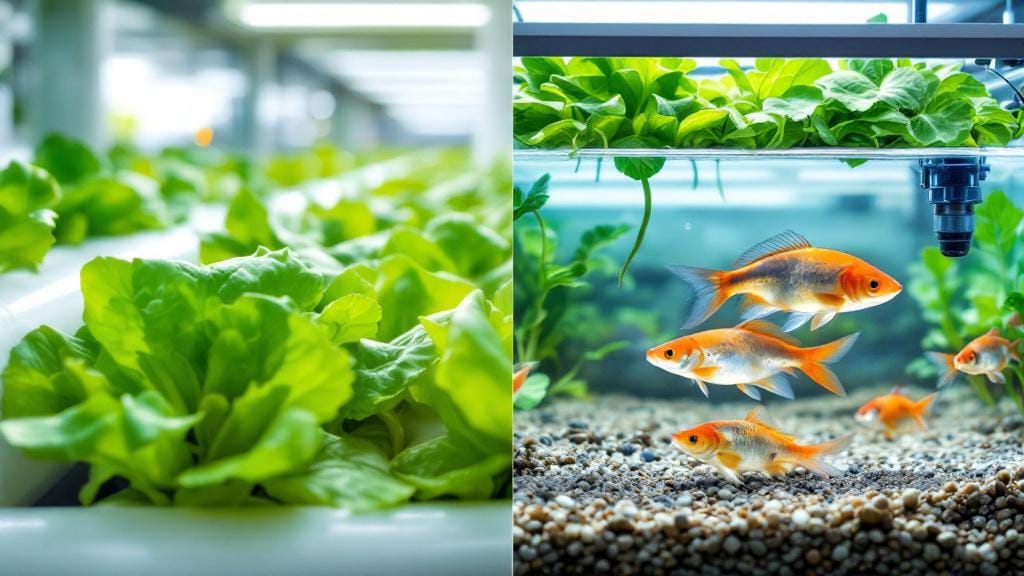
The main difference between hydroponics and aquaponics lies in where the nutrients come from.
- Hydroponics uses a man-made, chemically formulated nutrient solution that must be mixed and maintained by the grower.
- Aquaponics uses natural nutrients generated from fish waste, relying on living organisms to sustain the system.
Put simply:
➡ Hydroponics is a plant-only system powered by artificial nutrients.
➡ Aquaponics is a living ecosystem powered by fish, bacteria, and plants working together.
This distinction drives several other differences related to cost, maintenance, sustainability, crop variety, and long-term operation.
Key Differences Between Hydroponics and Aquaponics
1. Nutrient Source
Hydroponics
- Uses liquid nutrient concentrates added manually.
- Nutrients must be monitored and replenished frequently.
- Provides precise control over nutrient composition.
Aquaponics
- Nutrients come from fish waste and microbial activity.
- System stability depends on maintaining a healthy fish population.
- Nutrient profiles are more natural but less customizable.
2. System Complexity
Hydroponics
- Mechanically simpler: only plants and water systems to manage.
- Easier for beginners to set up and troubleshoot.
Aquaponics
- More complex due to living components:
- Fish health
- Water quality
- Biofiltration
- Bacteria colonization
- Requires more training and system balancing.
3. Environmental Sustainability
Hydroponics
- Uses less water than soil-based farming, but:
- Nutrient solutions eventually need disposal.
- Some chemical runoff can harm ecosystems if not handled properly.
Aquaponics
- Zero chemical fertilizers.
- Water recirculates in a closed loop with minimal waste.
- Highly sustainable and environmentally friendly.
4. Startup and Operating Costs
Hydroponics
- Lower initial cost because there is no fish tank, fish, or biofilters.
- Higher ongoing costs due to nutrient solution purchases.
Aquaponics
- Higher initial investment:
- Fish tanks
- Pumps
- Biofilters
- Fish stock
- Lower long-term nutrient costs since fish supply ongoing nutrition.
5. Crop Variety
Hydroponics
- Suitable for virtually any crop:
- Lettuce
- Herbs
- Tomatoes
- Peppers
- Strawberries
- Cucumbers
Aquaponics
- Best suited for leafy greens and herbs.
- Fruit-bearing plants can grow but may need supplemental nutrients at times.
- Heavier feeders may strain the nutrient cycle.
6. Growth Rate and Yield
Hydroponics
- Typically, faster plant growth due to precise nutrient control.
- Optimized settings can maximize yields consistently.
Aquaponics
- Growth may be slightly slower at first.
- Yields stabilize once the ecosystem matures.
- Offers dual outputs: produce + fish.
Pros and Cons of Each System
Hydroponics Pros
- Precise control over nutrients.
- Predictable plant growth.
- No fish or biological cycles to manage.
- Smaller learning curve and easier automation.
Hydroponics Cons
- Ongoing cost of chemical nutrients.
- Disposal of nutrient solution can raise environmental concerns.
- More vulnerable to system failure, plants die quickly without nutrients.
Aquaponics Pros
- Highly sustainable and chemical-free.
- Uses 90% less water than soil gardening.
- Produces both vegetables and edible fish.
- Natural ecosystems reduce the need for external inputs.
Aquaponics Cons
- More complex to start and maintain.
- Sensitive to imbalances in fish health and water chemistry.
- Higher upfront costs and a slower startup cycle.
Which System Is Better?
If you decide that the faster growth of hydroponics is for you, make sure you follow the right steps on how to start seedlings for hydroponics to ensure your project’s success.
The better system depends on your goals.
Choose Hydroponics If You Want:
- Faster crop production
- High control over plant nutrition
- Low biological complexity
- Compact, indoor-friendly setups
Choose Aquaponics If You Want:
- A sustainable, eco-friendly growing method
- Organic produce without synthetic nutrients
- A dual system that produces fish and vegetables
- A long-term, self-sustaining ecosystem
While both hydroponic and aquaponic systems eliminate the need for soil and enable highly efficient growing, the main difference between them is the source of nutrients. Hydroponics relies on man-made nutrient solutions, giving growers precision and simplicity, while aquaponics uses natural nutrients generated from fish waste, creating a balanced ecosystem that supports both plant and fish production.
Hydroponics excels in control and speed, while aquaponics leads in sustainability and long-term efficiency. Understanding these differences helps you choose the system that aligns best with your budget, values, and agricultural goals. No matter which path you take, both systems represent the future of modern farming and gardening, offering a path to fresh produce even in the most urban environments.


